An outbreak of the Zika virus in 2016 caused great concern among the general public and generated a burst of tweets. The aim of this study was to develop a better understanding of the types of discussions taking place. Tweets were retrieved from the peak of the Zika outbreak (as identified by Google Trends). Tweets were then filtered and entered in NVivo to be analysed using thematic analysis. It was found that tweets on Zika revolved around seven key themes: pregnancy, travel and the Olympics, mosquitoes and conspiracy, health organisations, health information, travel and tracking, and general discussions around Zika. Our results are likely to be of interest to public health organisations disseminating information related to future outbreaks of Zika and we develop a set of preliminary recommendations for health authorities.
As social distancing continues and covid-19 patients self-isolate, there are many coronavirus conspiracy theories which have been spreading on social media platforms. One of them has been falsely claiming that 5g technology has been responsible for the spread of the virus.
Other conspiracy theories have traced the origin of the virus to the Chinese government as a biological weapon. Australia hit back at the United States for the link that put a connection between the Wuhan Institute of Virology and COVID-19, and the New York Times noted that China Lab rejected the claims.
Fact checking has been more important than ever as there are other 10 current conspiracy theories, for instance, see this article COVID: Top 10 current conspiracy theoriesand one of them involves Bill Gates as a scapegoat. The World Health organisation has noted that during the coronavirus pandemic a battle against false information has also been taking place. Fact-checking has been more important than ever during the covid-19 pandemic. As conspiracy theorists run rampant across the digital landscape.
It has become more important to rapidly analyse content from social media platforms to understand the drivers of false news and to develop strategies to fight misinformation. In our latest studies published in the Journal of Medical Internet Research (JMIR) entitledCOVID-19 and the 5G Conspiracy Theory: Social Network Analysis of Twitter Data we analyse the 5G Covid-19 conspiracy theory. More specifically, we set out to investigate which Twitter users and Web sources were influential.
We found that Infowars and other fake news websites were influential and Twitter users linked to YouTube videos which argued for the link between 5G and COVID-19. We also found that an individual account was set up to spread the conspiracy theory which should have been taken down by Twitter much sooner.
Overall we found that only a handful of users truly believed the conspiracy theory (35%), and others users inadvertently raised its profile to make it a trending topic on Twitter. We recommend that other Twitter users report such misinformation rather than engage and/or amplify it.
Since the beginning of December 2019 COVID-19 has spread rapidly around the world which has led to increased discussions across online platforms. These conversations have also included various conspiracies shared by social media users. Amongst them a popular theory has linked 5G to the spread of COVID-19 leading to misinformation and the burning of 5G towers in the United Kingdom. The understanding of the drivers of fake news and quick policies oriented to isolate and rebate misinformation are key to combating it.
Objective:
To develop an understanding of the drivers of the 5G COVID-19 conspiracy theory and strategies to deal with such misinformation
Methods:
This paper performs a Social Network Analysis and Content Analysis of Twitter data from a 7-day period in which the #5GCoronavirus hashtag was trending on Twitter. Influential users are analyzed through social network graph clusters. The size of the nodes is ranked by their betweenness centrality score and the graph’s vertices are grouped by cluster using the Clauset-Newman-Moore algorithm. Topics and Web sources utilized by users are examined.
Results:
Social Network Analysis identified that the two largest network structures consisted of an isolates group and a broadcast group. The analysis also reveals that there was a lack of authority figure who was actively combating such misinformation. Content analysis reveals that only 35% of individual tweets contained views that 5G and COVID-19 were linked whereas 32% denounced the conspiracy theory and 33% were general tweets not expressing any personal views or opinions. Thus, 65% of tweets derived from non-conspiracy theory supporters which suggests that although the topic attracted high volume only a handful of users genuinely believed the conspiracy. This paper also shows that fake news websites were the most popular Web-source shared by users although YouTube videos were also shared. The study also identified an account whose sole aim was to spread the conspiracy theory on Twitter.
Conclusions:
The combination of quick targeted interventions oriented to delegitimize the sources of fake information are key to reducing their impact. Those users voicing their views against the conspiracy theory, link-baiting, or sharing humorous tweets inadvertently raised the profile of the topic, suggesting that policymakers should insist in the efforts of isolating opinions which are based on fake news. Many social media platforms provide users with the ability to report inappropriate content. This study is the first to analyse the 5G conspiracy theory in the context of COVID-19 on Twitter offering practical guidance to health authorities in how, in the context of a pandemic, rumors may be combated in the future.
Dr Wasim Ahmed, University of Newcastle, UK; Dr Opeoluwa Aiyenitaju, Manchester Metropolitan University, UK; Professor Simon Chadwick, Emlyon Business School, France; Dr Alex Fenton, University of Salford, UK.
Joe Wicks, the British fitness coach who initially shot to prominence on Instagram, is continuing to engage children and fitness fanatics across the world. With many people either social isolating or locked down, Wicks’ daily P.E. workouts delivered via YouTube have become a staple of household routines.
In an earlier article, we noted how Wicks’ workouts have driven the development of a huge social media communications network. This includes via platforms such as Instagram and Twitter. We are still monitoring Wicks and his influence in a research project that uses mixed methods research.
The questions underpinning our analysis are: What is the nature of the health and well-being content being generated by this influencer? How is it moving through social media networks? And what is user sentiment towards this content?
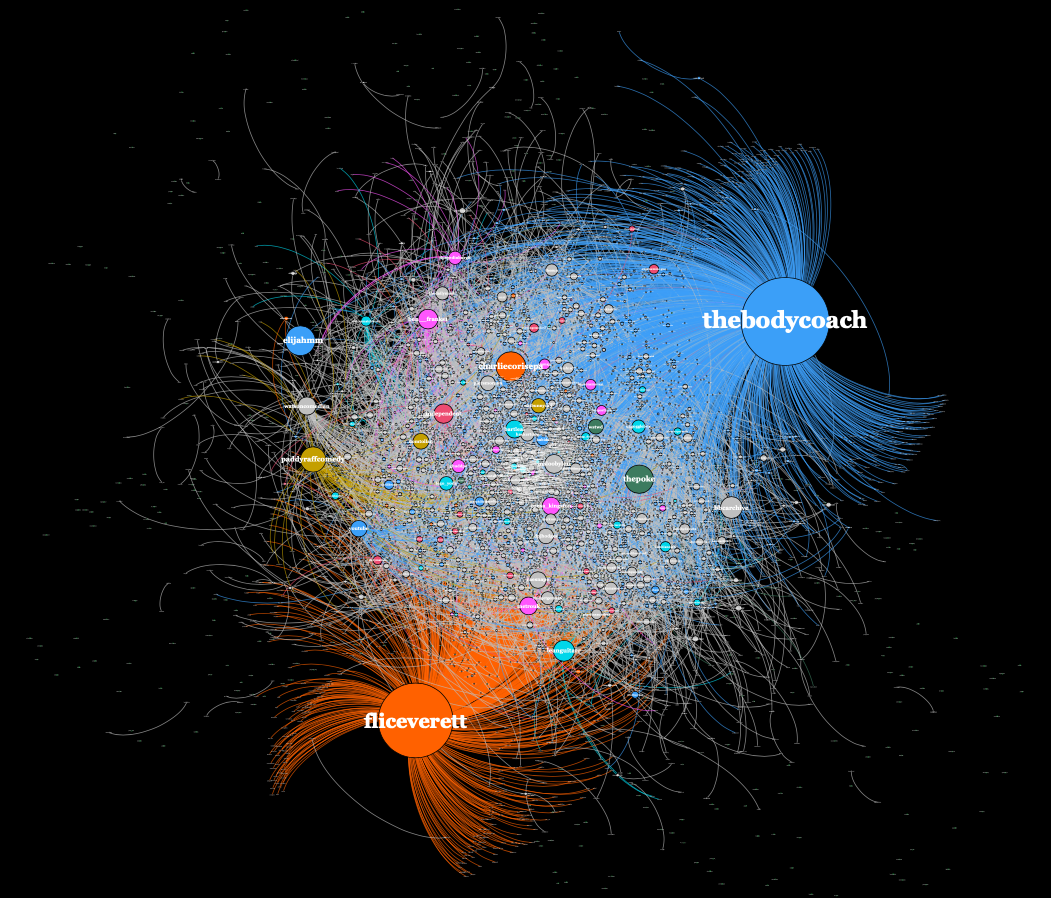
Following our latest analysis of communications posted by and about Joe Wicks, we have identified that they appear in a form that is something akin to a constellation (Figure 1). In this pattern of communications, Wicks is the big influencer star, although he is surrounded by a host of other influencer stars albeit ones that shine less brightly in this context.
Figure 1: The Joe Wicks social media constellation
A closer examination of the constellation (which we refer to as the #Wicksophere) reveals the identities of other influencer stars in the constellation. Among these are television personality and journalist Piers Morgan, and writer and journalist Caitlin Moran (see Figure 2).
Figure 2: Star influencers in the Joe Wicks constellation
This observation is consistent with our earlier findings that Wicks constitutes the focal node in a broadcast network form, but that content about him is in turn driven by a series of other high profile, often famous personalities and influencers.
However, in this iteration of our study we employed a measure of betweenness centrality — a measure of the ‘influence of a vertex over the flow of information between every pair of vertices under the assumption that information primarily flows over the shortest paths between them’.
This revealed a significant influencer over the last week or so has been an individual tweeting via the account @fliceverett (see Figure 3). This person is neither famous nor an established social media influencer. Instead, she impacted upon the flow of communications about Joe Wicks following a posting set in the context of peoples’ Covid-19 coping strategies (see Figure 4).
Figure 3: Flic Everett as a social media influencer
Figure 4: Flic Everett’s influencer posting on Twitter
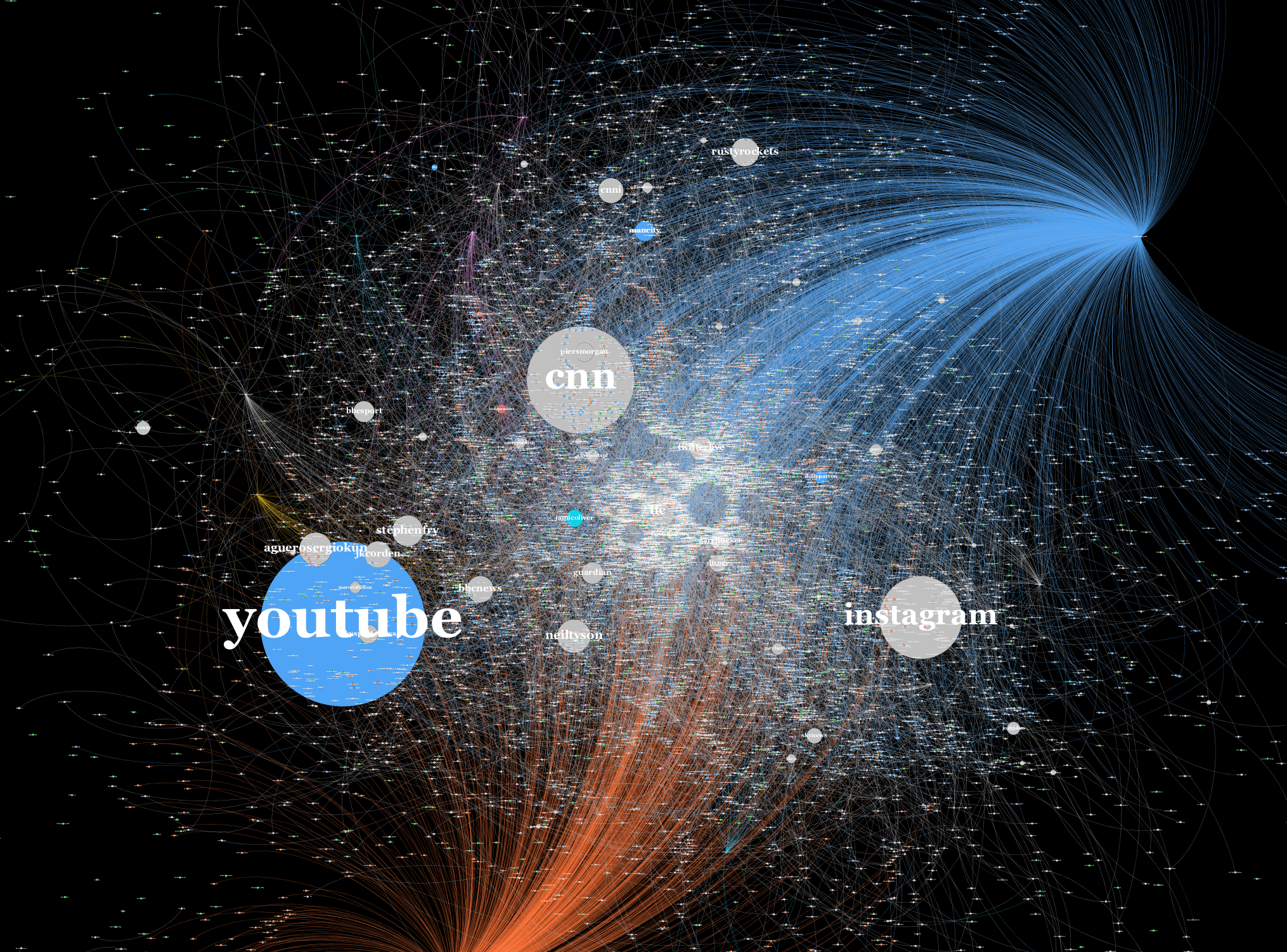
Nevertheless, when we switched the nodes and labels associated with Wicks’ constellation to rank by number of followers rather than betweenness centrality, perhaps a slightly more stable view of the universe emerged (see Figure 5).
It is interesting to note that in this version of the constellation, planets such as comedian Stephen Fry and footballer Sergio Aguero are orbiting the suns of YouTube, CNN and Instagram. One can still see the space dust trajectory around Joe Wicks and Flic Everett, but one needs a more powerful telescope to zoom in and see them.
Figure 5: Wicks’ constellation with nodes ranked by number of followers
Our work examining Joe Wicks, social influencers and public health policy continues. Hence, we will be reporting again soon via this and our other digital channels. For the time-being, we nevertheless conclude that Wicks continues to be a significant public health influencer during this period when schools and other institutions are in lockdown.
We also note the space dust glitterati of influencers congregated around Wicks. However, we now also note that the meteor shower of influencers from within the general population may also periodically shoot through social media constellations.
Furthermore, it is clear from our initial work here that how one employs techniques of social network analysis also influences how collectively we view people such as Joe Wicks, Flic Everett and Piers Morgan.
This blog was originally posted on Professor Simon Chadwick’s Medium blog.
Great to see our fully open access journal article go online today which aims to build an understanding of how social media may play a role in the global dissemination of amateur and unfounded speculation against accepted medical research. This research is significant because we find medical studies being socially challenged by various social media networks at an increasing rate.
Entitled: ‘Contextualising the 2019 E-Cigarette Health Scare: Insights from Twitter’ link below.
Athletes in all sports increasingly need to be visible across social media in order to build their brands. This article takes a look at the social network aftermath of Tyson Fury v.s. Deontay Wilder.







 Dr. Wasim Ahmed