Very pleased to see my 2019 edition of “Using Twitter as a data source: an overview of social media research tools” go live on the @LSEImpactBlog !

Be sure to check it out here: https://blogs.lse.ac.uk/impactofsocialsciences/2019/06/18/using-twitter-as-a-data-source-an-overview-of-social-media-research-tools-2019/

Abstract: 
Twitter and other social media platforms represent a large and largely untapped resource for social data and evidence. In this post, Wasim Ahmed updates his recurring series on the Impact Blog, to bring you the latest developments in digital methods and methodologies for researching Twitter and other social media platforms.


Social Media and Journalism: Methods and Tools

This post is based on my 2018 journal article for Online Information Review titled ‘Social media analytics: analysis and visualisation of news diffusion using NodeXL’ .

In this paper I wrote that

“One well-known case of news emerging through Twitter before traditional media outlet was the death of Osama Bin Laden which was leaked on the platform (Hu et al., 2012). Moreover, Hu et al (2012) noted that one of the reasons for Twitter users to become convinced of this news was because the users who were posting the news appeared to be journalists and politicians i.e., reputable individuals. Twitter also has potential for citizen journalism because most smartphones are now able to capture an image on their device and have it uploaded to Twitter in under 45 seconds (Murthy, 2011). An iconic example of this is a passenger on the Midtown Ferry whom photographed a downed U.S Airways jet floating in the Hudson river in 2009 prior to the mainstream media even arriving to the scene  (Murthy, 2011). These cases highlight the power of Twitter in the rapid cascading and diffusing information during emerging news events. ” (Ahmed, 2018 p3)

In the passage above I noted the role of Twitter as a tool for breaking news stories and citizen journalism. It is also important to note that Twitter is also used by politicians and journalists with particular affiliations to try and shape public discourse.

In the paper I argued that better tools and methods are required to be able to critically analyse, visualize and understand the swarm of content being generated by social media platforms such as Twitter. I noted that:

“However, it can be argued that Twitter has been poorly mapped and understood for its network properties by news media. This is because although it is possible to visualise the structure of a conversation on Twitter and to identify prominent users and the overall structure of the conversation in order to garner the situational awareness of an emerging news story this aspect of Twitter is seldom reported on by news media.” (Ahmed, 2018 p.9)

The tool that I outlined which can be used by journalists to map and visualise social media is known as NodeXL. In the paper I noted that:

NodeXL allows end-users to generate network visualisations from a range of data sources and one such source is Twitter. In the case of Twitter NodeXL can additionally generate a number of metrics associated with the graphs such as:

  • The most frequently shared URLs
  • Domains
  • Hashtags
  • Words
  • Word Pairs
  • Replied-To
  • Mentioned Users
  • Most frequent tweeters

(Ahmed, 2018 p.5)

I then went on to provide a table for how NodeXL could be used by journalists.

Table 1

General Goals for Newsrooms How to Achieve Goal
 

Determine dominant external media narratives shared on social media during an evolving news event.


Examine most frequently shared URLs, domains, and hashtags in NodeXL.
Establish different discussions that are taking place based on an emergent new development.  

Examine the different groups that emerge by examining the different groups and to interpret the most frequently occurring words, word pairs in order to understand the discussions that are taking place.


Discover main information diffusers during a developing news story and/or a topic of interest.  

To identify users influential using the metric of betweenness centrality and/or to identify broadcast hubs within network visualisations which show prominent users.


Learn about general key players during an emerging news event.  

To examine metrics within Twitter such as replied-to, mentioned users, and most frequent tweeters


Ascertain users who are concerned with an evolving news event.


To locate users who have been tweeting the most.

Table recreated from Ahmed (2018 p.8)

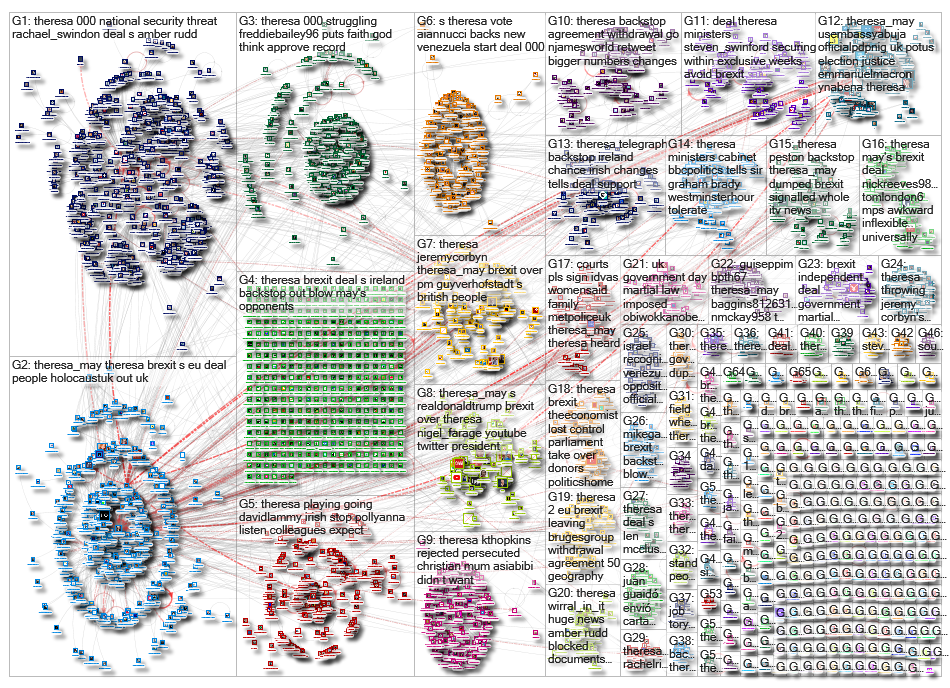
In the paper I provide the example of #MacronLeaks, however, below I have provided a network visualization of the keyword ‘Theresa May’.

Figure 1 – Network visualization of Theresa May

Theresa May_2019-01-27_23-26-06.xlsx

The above network graph resembles a number of different shapes and we can interpret them drawing on guidance from Smith et al (2014) which outlines different types of network structures.

Figure 2 – Different Types of Network Structure

6 types of network structure

We can then work through the full analytics (found here) and begin to complete Table 1 taking on board the guidance provided. For instance, to understand some of the main narratives we can take a look at most shared URLs, domains, and hashtags in NodeXL. This will then provide insight into some of the key narratives related to Theresa May on Twitter.

References

Ahmed, W., & Lugovic, S. (2018). Social Media Analytics: Analysis and Visualisation of News Diffusion using NodeXL. Online Information Review.

Hu, M., Liu, S., Wei, F., Wu, Y., Stasko, J., Ma, K.-L., 2012. Breaking News on Twitter, in: Proceedings of the SIGCHI Conference on Human Factors in Computing Systems, CHI ’12. ACM, New York, NY, USA, pp. 2751–2754. https://doi.org/10.1145/2207676.2208672

Murthy, D., 2011. Twitter: Microphone for the masses? Media Cult. Soc. 33, 779–789.

Smith, M.A., Rainie, L., Shneiderman, B. and Himelboim, I. (2014), “Mapping Twitter topic networks:
from polarized crowds to community clusters”, Pew Research Center, Vol. 20, pp. 1-56.

Social media and the social sciences: methods and tools for academic research

Social media as a research tool has gained in popularity in recent years. Those new to the field may wish to know about the key methodologies and tools that can be used for the analysis of data. This post will provide a round-up of popular methods and tools for the analysis of social media data.

Although there will be a number of ways to build custom scripts for the analysis of data; it remains that pre-existing tools remain popular for social science scholars as it removes the need for development skills. Twitter remains the most utilised platform and will be the focus of this post.

New event for 2019! Social Media & Digital Humanities: Methods/Approaches For Social Scientists

As a wrote in my 2015 LSE Impact blog post:

  • Sentiment analysis works well with social media data, as posts may be  consistent in length
  • Time series analysis is normally used when examining posts overtime to see when a peak of social media posts may occur
  • Network analysis is used to visualize the connections between people and to better understand the structure of the conversation.
  • Machine learning methods may work well with social media data because of the volume of tweets
  • Qualitative analysis methods  (such as thematic and content analysis) are rare for social media research, however, they can often offer up more depth than quantitative methods.

Read more here 

In terms of popular tools for the analysis of social media data a list of popular tools is populated below:

An overview of tools for 2019

Tool OS Download and/or access from Platforms*
Audiense Web-based https://buy.audiense.com/trial/new Twitter
Chorus (free) Windows (Desktop advisable) http://chorusanalytics.co.uk/chorus/request_download.php Twitter
COSMOS Project (free) Windows
MAC OS X
http://socialdatalab.net/software Twitter
Echosec Web-based https://www.echosec.net Instagram
Twitter
Foursquare
Panoramio
AIS Shipping
Sina Weibo
Flickr
YouTube
VK
Followthehashtag Web-based http://www.followthehashtag.com Twitter
Mozdeh Windows (Desktop advisable) http://mozdeh.wlv.ac.uk/installation.html Twitter
Netlytic Web-based https://netlytic.org Twitter
Facebook
YouTube
Instagram
RSS Feed
NodeXL Windows http://nodexl.codeplex.com Twitter
YouTube
Flicker
NVivo Windows and MAC http://www.qsrinternational.com/product Twitter
Ability to import
SocioViz Web-based http://socioviz.net Twitter
Trendsmap Web-based https://www.trendsmap.com Twitter
Twitonomy Web-based http://www.twitonomy.com Twitter
Twitter Arching Google Spreadsheet (TAGS) Web-based https://tags.hawksey.info Twitter
Visibrain Web-based http://www.visibrain.com Twitter
Webometric Analyst Windows http://lexiurl.wlv.ac.uk Twitter (with image extraction capabilities)
YouTube
Flickr
Mendeley
Other web resources

The tools above can be used in a manner to conduct academic research that many may believe that is not possible!

Published research that may be of interest:

Downing, J & Ahmed, W (2019). #MacronLeaks as a “warning shot” for European democracies: challenges to election blackouts presented by social media and election meddling during the 2017 French presidential election.

Vidal-Alaball J., Fernandez-Luque L., Marin Gomez FX., Ahmed W (2019). A New Tool for Public Health Opinion: Using Twitter Polls for Insight into Telemedicine. JMIR Formative Research. ( 2018 Journal Stats from Web of Science)

Ahmed, W., Bath, P.A, Sbaffi, L., Demartini, G. (2019). Novel insights into views towards H1N1 during the 2009 Pandemic: a thematic analysis of Twitter data. Health Information and Libraries Journal (2018 impact factor ).

Ahmed, W., & Lugovic, S. (2019). Social Media Analytics: Analysis and Visualisation of News Diffusion using NodeXL. Online Information Review. (2018 Impact Factor: 1.928).

Zhang, Z., & Ahmed, W (2018). A Comparison of Information Sharing Behaviours across 379 Health Conditions on Twitter. International Journal of Public Health. (2018 impact factor 2.373) 

Ahmed, W. (2018) Public Health Implications of #ShoutYourAbortion. Public Health Journal.  (2018 Impact Factor 1.696). 

Ahmed, W. (2018) Using Social Media Data for Research: An Overview of Tools. Journal of Communication Technology.

Samuel, G., Ahmed, W., Kara, H., Jessop, C., Quinton, S., & Sanger, S. (2018). Is It Time to Re-Evaluate the Ethics Governance of Social Media Research?. Journal of Empirical Research on Human Research Ethics, 1556264618793773.

Ahmed, W., Bath, P.A., & Demartini G (2017) Using Twitter as a data source: An overview of ethical challenges.  Advances in Research Ethics and Integrity (Eds). Emerald Books.

New publication: A comparison of information sharing behaviours across 379 health conditions on Twitter

A comparison of information sharing behaviours across 379 health conditions on Twitter in International Journal of Public Health

Abstract

Objectives

To compare information sharing of over 379 health conditions on Twitter to uncover trends and patterns of online user activities.

Methods

We collected 1.5 million tweets generated by over 450,000 Twitter users for 379 health conditions, each of which was quantified using a multivariate model describing engagement, user and content aspects of the data and compared using correlation and network analysis to discover patterns of user activities in these online communities.

Results

We found a significant imbalance in terms of the size of communities interested in different health conditions, regardless of the seriousness of these conditions. Improving the informativeness of tweets by using, for example, URLs, multimedia and mentions can be important factors in promoting health conditions on Twitter. Using hashtags on the contrary is less effective. Social network analysis revealed similar structures of the discussion found across different health conditions.

Conclusions

Our study found variance in activity between different health communities on Twitter, and our results are likely to be of interest to public health authorities and officials interested in the potential of Twitter to raise awareness of public health.


The full paper can be accessed here: https://link.springer.com/article/10.1007/s00038-018-1192-5

Presented paper and won award at 9th International Social Media and Society Conference

These days I am working as an Assistant Professor at Northumbria University, recently, I presented a paper based on my PhD research, recently completed at the Information School based at the University of Sheffield, at the 9th International Social Media and Society Conference which had an acceptance rate of 47%.

The paper titled Moral Panic through the Lens of Twitter: An Analysis of Infectious Disease Outbreaks can be accessed here. The paper was also summarised in a blog post by Professor Axel Bruns, President of the Association of Internet Researchers (AoIR).

most active twitter user

At the awards ceremony, I received the award of ‘most engaged Twitter user’ and won a series of prizes (pictured above). The hashtag for the conference contained over 400 unique users, and generated over 2,500 unique tweets and became a trending topic in Copenhagen (where the conference was taking place).

New publication for The Conversation

I have had the following article “Croatia’s World Cup consolation: Google searches soar as world seeks information on finalists” published for The Conversation, be sure to check it out here: https://theconversation.com/croatias-world-cup-consolation-google-searches-soar-as-world-seeks-information-on-finalists-99959?utm_source=twitter&utm_medium=twitterbutton

PhD thesis published: Using Twitter data to provide qualitative insights into pandemics and epidemics

Just a quick update to say that my PhD thesis has now been published which was titled:

Using Twitter data to provide qualitative insights into pandemics and epidemics

The thesis can be accessed by following this link: http://etheses.whiterose.ac.uk/20367/

The abstract is provided below:

Background: One area of public health research specialises in examining public views and opinions surrounding infectious disease outbreaks. Although interviews and surveys are valid sources of this information, views and opinions are necessarily generated by the context, rather than spontaneous. As such, social media has increasingly been viewed as legitimate source of pragmatic, unfiltered public opinion.

Objectives: This research attempts to better understand how users converse about infectious disease outbreaks on the social media platform Twitter. The study was undertaken in order to address a gap in knowledge because previous empirical studies that have analysed infectious disease outbreaks on Twitter have focused on employing quantitative methods as the primary form of data analysis. After analysing individual cases on Ebola, Zika, and swine flu, the study performs an important comparison in the types of discussions taking place on Twitter and is the first empirical study to do so.

Methods: A number of pilot studies were initially designed and conducted in order to help inform the main study. The study then manually labels tweets on infectious disease outbreaks assisted by the qualitative analysis programme NVivo, and performs an analysis using the Health Belief Model, concepts around information theory, and a number of sociological principles. The data were purposively sampled according to when Google Trends Data showed a heightened interest in the respective outbreaks, and a case study approach was utilised.

Results: A substantial number of themes were uncovered which were not reported in previous literature, demonstrating the potential of qualitative methodologies for extracting greater insight into public health opinions from Twitter data. The study noted several limitations of Twitter data for use in qualitative research. However, results demonstrated the potential of Twitter to identify discussions around infectious diseases that might not emerge in an interview and/or which might not be included in a survey.

New post for the LSE Impact blog

I published a new blog post for the LSE Impact blog examining the implications of Twitter’s 280-character increase on academic research. The abstract is copied below and a link is provided to the full entry.

Abstract 

Twitter makes its data available in real-time and at no cost, making it a popular data source for many academic researchers. Wasim Ahmed discusses some of the implications of the decision to expand the character limit from 140 to 280. Greater space makes for greater depth and detail, addressing the difficulties of interpretation that 140-character tweets would sometimes present. However, some data retrieval tools have been slow to catch up, and the change may also make historical comparisons problematic. Overall, the character increase is of value to researchers and should inspire further innovative and exciting research.

Read my full post here:

http://blogs.lse.ac.uk/impactofsocialsciences/2018/02/09/more-room-for-greater-depth-and-detail-implications-for-academic-research-of-twitters-expanded-character-limit/

Peer reviewed book chapter on the ethical, legal, and methodological challenges of researching Twitter is now open access!

Abstract


You can access the book chapter here: http://eprints.whiterose.ac.uk/126729/

Social Media: A Force for Good or Evil?

Earlier this week I had the pleasure of hosting a debate at Sheffield Hallam University for charity, a part of 24 hours of debate. The topic of debate I selected was to look at whether social media had been a positive or negative invention. The attendees were mostly undergraduate students, so I was really interested to get their thoughts on this topic.

social media force for good or evil

Before kicking off the debate I broke down the current usage of social media such as:

Of an estimated global population of 7.524 billion – there are 3.028 billion total social media users (37% of the total population).
• That the average mobile phone user spends 2 hours on their phone a day, and touches their phone 2,617 times a day.

In order to have an informed debate I outlined some benefits of social media such as:

Ability to Connect: we now have the ability to connect with one another from across the world.

Used in Education: across academia social media is used for teaching and for scholarly communication.

Marketing: social media has created a number of jobs in a marketing context, and helped small business thrive.

 • Politics and Political Change: social media has been credited as being influential during political uprisings.

• Awareness: it is possible to rapidly raise awareness for causes. We can think of the Ice bucket challenge as an example of how social media can be used to raise awareness.

• Emergency and Crisis Situations: in times of crisis data from social media platforms can be leveraged, and this has the potential to save lives.

I also considered some of the limitations of social media such as:

• Cyberbullying / Mental Health: there is the issue of virtual bullying, and potential negative mental health among users.

• Hacking: there are a number of cases where identity theft has occurred, and this has had a disastrous effect on people’s lives. Private photographs can also be stolen.

• Addiction: social media platforms are designed to be addictive, and there may be people who are addicted to the platforms without knowing.

• Unknown effects: there could also be a number of unknown consequences of using social media platforms that we are not currently aware of.

After providing an overview of a number of strengthens and limitations I then looked to consider some questions to be debated which were as followed:

• Do the benefits of social media outweigh the limitations?

In the discussion some thought that the benefits of social media did outweigh the limitations whereas others thought the opposite. Overall, however, there was agreement that there were more benefits that social media platforms offered. Particularly in the ability to connect with one another, create events, and socialise. Though this answer could reflect the views of the audience discussing the topic i.e., undergraduate students.

• Is social media making us less social?

There appeared to be strong agreement that social media had made younger generations less social. Discussion would then turn to whether it is the role of parents to ensure children were not spending too much time on social media. This then lead on to discussions around the digital divide and how parents may not fully understand the risks of these platforms themselves to be able to keep on top of things.

• Has social media had a positive or negative effect on society?

There was disagreement but the overall consensus was that social media platforms were here to stay. Therefore, the delegates argued that there should be more regulation and guidance for children who may be using these platforms. There were also sentiments expressed by delegates noting that we probably do not know all of the effects social media has had among society.

• What effect have social media had on our mental health?

There was agreement that social media platforms had the potential to cause negative mental health among users. An example was provided of a case of private photographs of a teenager being spread around social media without their consent and the damage that this can cause. Some argued that the challenges posed by social media have always existed in society. Others argued that although this may be the case social media has increased the speed in which information can be spread.

• Have social media companies unfairly exploited our desire to connect with one another?

There was disagreement because some thought that social media companies had operated fairly and lawfully. Whereas others argued that the terms and conditions of social media platforms were so long that many were not reading them. Others thought that people should be reading the terms and conditions of social media platforms more regularly.

• Is social media going to change how people live their lives e.g., a comment made when young and naïve can come back to haunt.

There was disagreement among the delegates and one delegate suggested that comments made after a certain age e.g., 16 should be public knowledge for certain professions such as politics. However, this was not a popular view. Most thought that it would not be fair to judge someone for comments that they might make when they are young. The discussion then revolved around how it would be possible to educate younger generations more.

Overall it was an interesting discussion and a range of opinions were discussed. It appeared that the consensus was that social media, on the whole, had more good elements but that care was needed by younger generation using the platforms.

New event for 2019 (online attendance possible):

Social Media & Digital Humanities: Methods/Approaches For Social Scientists